
In the sprawling darkness of Sanctuary, even the most battle-hardened wanderer can feel a chill of loneliness. Diablo 4’s Vessel of Hatred expansion, released back in 2024, took a bold stride to remedy that with the introduction of four unique mercenary companions. These aren't the silent, robotic helpers that follow players around in many action RPGs. No—these mercenaries bring their own baggage, opinions, and, most importantly, personality. As of 2026, the system has aged like fine wine, proving that a little character can transform a hack-and-slash routine into an emotional journey.
The standout feature of Vessel of Hatred’s mercenaries is how vividly they are written. Each one feels less like a tool and more like a travel companion who just happens to sling spells or swing an axe. Let’s start with Raheir, the Shield Bearer. He’s a giant of a man with a love for rum so deep you can almost smell the oak barrels on his breath. Despite his imposing frame, Raheir wears his heart on his sleeve more often than not. He’s constantly talking about his adopted daughter, Fayira, and the pride in his voice is utterly disarming. You might expect a shield-bearing brute to grunt orders, but instead he offers to buy the next round, his laughter booming through the jungle ruins of Nahantu. Talk about a gentle giant—he’s the dad of the group, and it shows.
Then there’s Aldkin, a childlike figure wrapped in mystery and immense power. When players first encounter him, he tries his best to appear menacing, putting on a spooky show to keep strangers away. But once those defenses crack, what emerges is a purity that’s almost heartbreaking. Imagine a kid who’s seen too much, yet still dreams of simple things. Aldkin’s voice carries an innocence that contrasts sharply with the demonic forces you’re fighting. 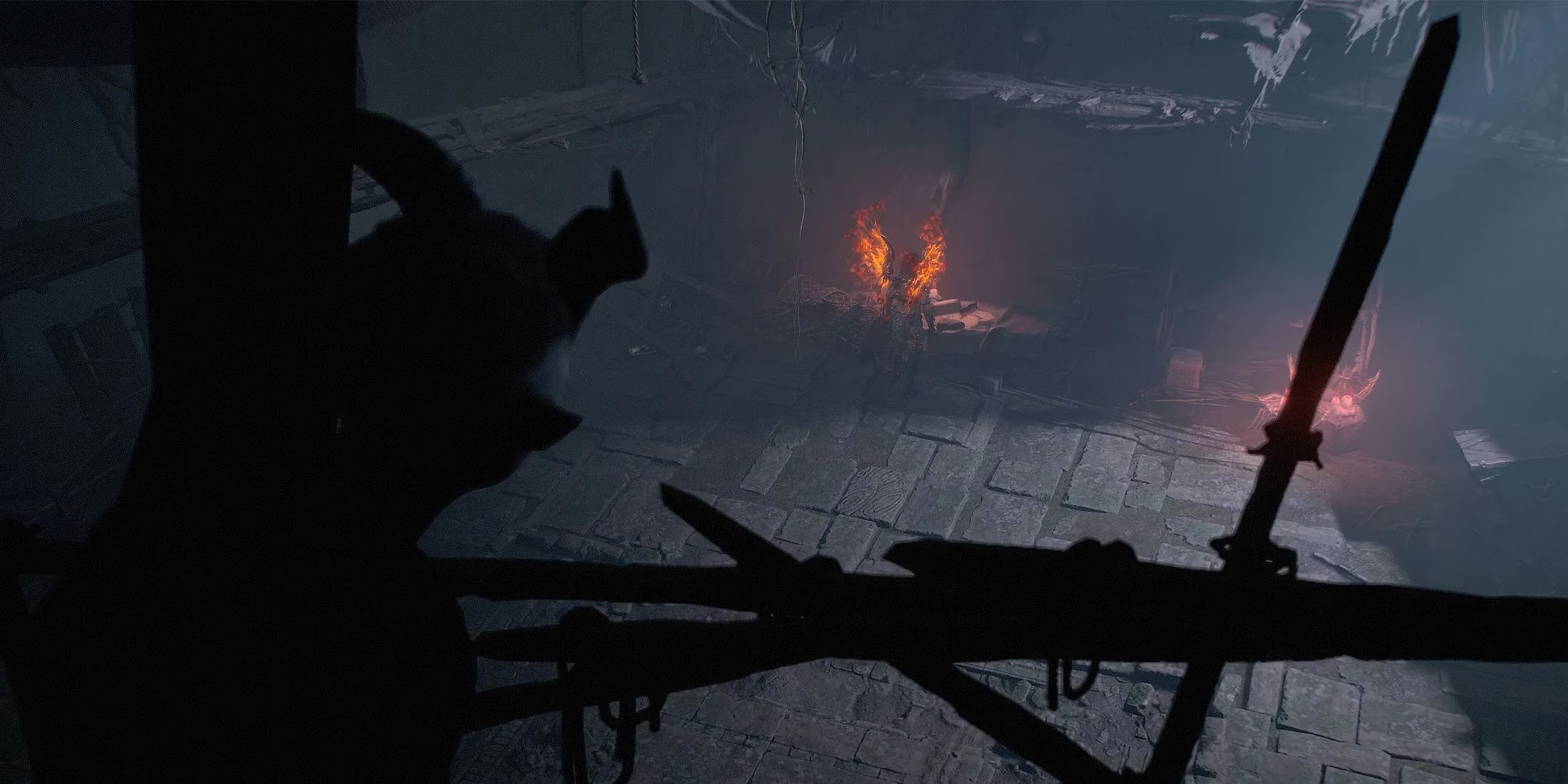 It’s in these quiet moments—standing in the Den, watching him fidget—that you realize this mercenary is more than a collection of combat scripts. He’s a story unfolding.
Subo, the Bounty Hunter, shifts the tone entirely. He’s ruthless, pragmatic, and not one for small talk. Money and reputation drive him, but he’s no one-dimensional antihero. Occasionally, he’ll let slip a comment that hints at a buried sense of loyalty. It’s as if he’s testing the player: will you stick around long enough to see the cracks in his armor? And honestly, that’s what makes him fascinating. You’re never quite sure if he’s going to save your life because it’s profitable or because he’s starting to care. That ambiguity keeps every trek through the swamps feeling unpredictable.
Varyana is perhaps the oddest of the bunch. A former cannibal with a code of absolute devotion, she’s unsettling yet deeply loyal. She rarely speaks about her past, and when she does, her voice drops to a whisper, as if the memories still have teeth. She prefers to stay on the outskirts, both in combat and in conversation, avoiding the temptation that once defined her. It’s a constant struggle you can sense in her brief, sharp remarks. Yet, when battle erupts, she’s a whirlwind of fury, her twin blades singing a song of redemption she’ll never fully claim. She’s the kind of character who makes you lean in, even when every instinct tells you to step back.
One of the most delightful design choices is how these mercenaries interact not just with the player, but with each other. Back at the Den, when you’re swapping gear or plotting the next bounty, you’ll often catch them mid-conversation. Raheir might be teasing Aldkin about his missing toy, while Subo chimes in with a dry remark about the dangers of attachment. These exchanges are priceless. They’re not scripted for you; they happen in the background, giving the mercenaries a life of their own. It’s like eavesdropping on a group of friends who’ve lived through hell together—and you’re just lucky enough to be invited.
However, it’s worth noting that the mercenaries don’t chatter endlessly while you roam Sanctuary. They mostly pipe up during specific story moments or when you’re back at base. Some might find this silence a missed opportunity—a chance to deepen the companionship during those quiet walks between combat. But perhaps that’s intentional. Diablo’s world is oppressive, and silence can be just as powerful as dialogue. The faint clink of Raheir’s armor or Aldkin’s quiet humming becomes its own language. Still, a few more roadside observations wouldn’t hurt; after all, what’s a road trip without a little backseat commentary?
In the years since Vessel of Hatred dropped, these mercenaries have become a benchmark for AI companions. Games released in 2025 and 2026 have tried to replicate the formula—characters that feel alive, not just functional. But Diablo 4 nailed it early by understanding that personality trumps raw utility. Players don’t remember the damage output of a companion; they remember the way Raheir’s voice cracks when he talks about Fayira, or the gentle rhythm of Aldkin’s steps. That emotional resonance is what transforms a mercenary from a stat block into a memory.
Looking back from 2026, the Vessel of Hatred expansion still stands as a lesson in narrative design. It proved that even in a loot-driven ARPG, the spaces between combat can be filled with genuine warmth, humor, and sorrow. The mercenaries of Nahantu didn’t just fight alongside players—they walked with them, and in doing so, made Sanctuary feel a little less empty. For a game built around endless cycles of death and rebirth, that’s a kind of immortality worth chasing.