
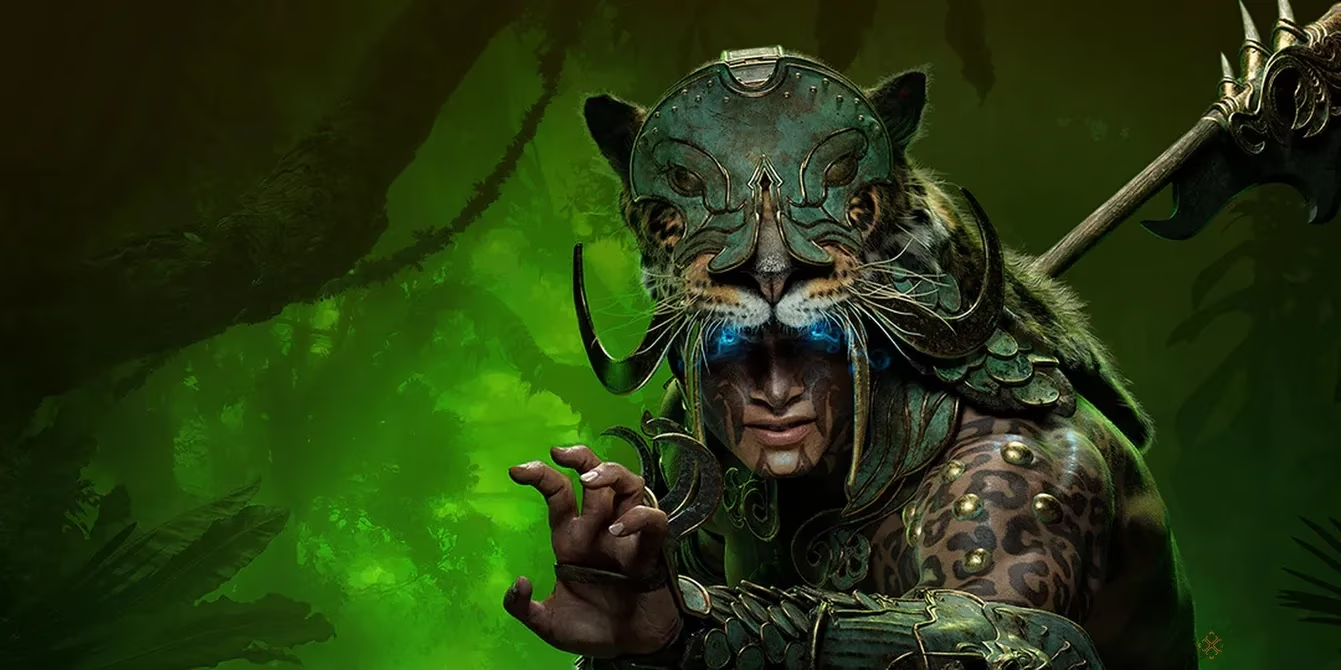
Back in the halcyon days of 2024, when Diablo 4’s Vessel of Hatred expansion first dropped, a curious phenomenon swept through Sanctuary. The Spiritborn class—already dripping with jungle mystique—unleashed a build so ludicrously overpowered that it turned Nephalem into caffeinated teleporting blenders. The Evade Eagle Spiritborn became an instant legend, letting players zip across Nahantu like Sonic the Hedgehog on a sugar rush while obliterating demons without ever breaking a sweat. Little did anyone know, the build’s god-tier mobility was actually a glitchy animation cancel exploiting frame breaks—and Blizzard’s nerf bat was already being polished.
🦅 The Rise of the Zoom-Bomber
The Evade Eagle setup revolved around Thunderspike, a skill that normally has a cooldown on your dodge. But clever (or accidental) button-mashers discovered that mashing Evade during certain animations cancelled the recovery frames, resulting in something that looked less like a deliberate dodge and more like a server desync fever dream. The result? Infinite, instant Evades that also spewed out colossal lightning damage. Maps became slip-’n-slides of electrified chaos; Helltides turned into casual sightseeing tours where your Spiritborn simply zoomed from one pack to another, leaving behind a trail of gold and glowing corpses. Enemies never even entered their attack animations. Bosses fell over before finishing their intro monologues. Co-op partners stood around wondering if they’d accidentally joined a cheat lobby.
Comment sections and Reddit threads lit up with testimonials: “I haven’t had this much fun since D2’s Enigma Teleport,” or the ever-classic, “It’s the only reason I’m still playing.” The build was so fast that hardcore players started using it as a commute option. The Spiritborn wasn’t just strong—it was a living meme, a blur of feathers and thunder that epitomized the phrase “broken but beautiful.”
🛠️ Enter the Fun Police
Then came the fateful tweet from Adam Fletcher, Diablo’s global community director. With a sigh that could be felt across the Twittersphere, he confirmed that the Evade Eagle’s lighting-fast dashes were, in fact, a bug: the Spiritborn was “breaking animation frames during Evade immediately.” Essentially, the game engine was having a stroke, and players were gleefully abusing its confusion. The fix would normalize Evade to its standard cast rate—no more instant chain-dodging, no more invincibility via sheer velocity. The patch was dropping within the week.
Blizzard’s reasoning? The zippy exploit was “impairing other players and their experience in-game.” In a game where screen clutter already rivals a fireworks factory explosion, a Spiritborn blinking around at 300 APM could make group content unreadable. But the community’s response was a collective, anguished “PLEASE DON’T!” Replies to Fletcher ranged from tearful pleas to logical arguments: Fix the visibility problem, don’t slaughter the fun. One player distilled it: “You can change everything else if it brings stability.” That sentiment echoed across forums, encapsulating the eternal tension between developer vision and player joy.
💸 Meanwhile, in the Real World…
Amid the uproar, it was hard to ignore the colossal elephant in the treasure room: Diablo 4 had already banked over $150 million in microtransactions by that point—and that was just post-launch cosmetic sales. Every demon-slaying zoomer buying a snazzy outfit kept the servers humming. The irony was delicious. Players were loudly declaring the game unplayable without their beloved bugged build, yet their wallets were singing a different tune. By 2026, that figure has bloated to an estimated $600 million in microtransactions alone, proving that for all the outrage, Sanctuary’s corridors are paved with platinum.
⏩ 2026: The Aftermath of the Nerf
Fast-forward two years. The Evade Eagle build was indeed fixed in a hotfix that many still refer to as “the Great Slowdown.” The Spiritborn class received balance adjustments, new aspects, and even a seasonal blessing that temporarily recreated a legal version of the zoom (albeit with a noticeable cooldown). Yet for dedicated veterans, nothing has ever quite captured the magic of that fleeting, unpredictable, gloriously broken week. Forums occasionally resurface screenshots of movement speed numbers that look like phone numbers, and someone inevitably comments: “Remember when Spiritborn could break the sound barrier?”
Blizzard has since learned to massage community reactions more carefully. When another build—the Toxic Tempest Necromancer—emerged in late 2025 with similarly screen-obliterating potential, the devs opted for a gentler adjustment while compensating with a unique legendary that rewarded the playstyle rather than deleting it. Perhaps the Evade Eagle saga taught them that sometimes a bug isn’t just a mistake; it’s a laboratory for unexpected fun.
📊 Player Sentiment Then vs. Now
| Era | Hot Takes | Overall Mood |
|---|---|---|
| 2024 (pre-nerf) | “Finally Diablo 4 feels fast!” | Euphoric 😍 |
| 2024 (post-nerf) | “Back to feeling like a lumbering bear.” | Saltier than the Dead Sea 😤 |
| 2025 | “New mobility aspects are decent.” | Cautiously optimistic 🤔 |
| 2026 | “Still miss the zoom, but game’s in a good place.” | Nostalgic with a side of whale 🐋 |
🤔 Why the Build Became Legendary
The Evade Eagle Spiritborn wasn’t just about power—it was about agency. In a genre where the difference between victory and defeat often hinges on tenth-of-a-second reactions, having a build that completely removes the friction of movement was intoxicating. It transformed Diablo 4 from a methodical ARPG into a twin-stick shooter you played with a single finger. For a brief, shining moment, you weren’t a Nephalem; you were a sentient lightning bolt on a caffeine drip.
So here in 2026, when a new player asks, “What was the most broken build ever?” the veterans will lean back, their eyes going glassy, and whisper: “Let me tell you about the time the eagle flew so fast it broke the game—and our hearts.”
Diablo 4 continues to thrive through seasonal content and the inexorable march of microtransaction-fueled development. The Vessel of Hatred may have sailed, but the memory of its swiftest bird remains eternally aloft.