
The Spiritborn arrived with Diablo 4's Vessel of Hatred expansion and immediately carved out a reputation as maybe the most flexible class the series has ever seen. Even two years later, in 2026, veteran players still argue that no other character can match its sheer variety of potent builds. While it echoes Diablo 3's Monk in many ways—the new Vortex skill is essentially Cyclone Strike with a fresh coat of paint—the Spiritborn doesn't just feel like a reskin. It’s the depth of its decision-making that sets it apart. From the very first playthrough, you can sense the class is slightly overtuned compared to the original roster, but its real magic lies in how many completely viable paths stand before you at any given moment.
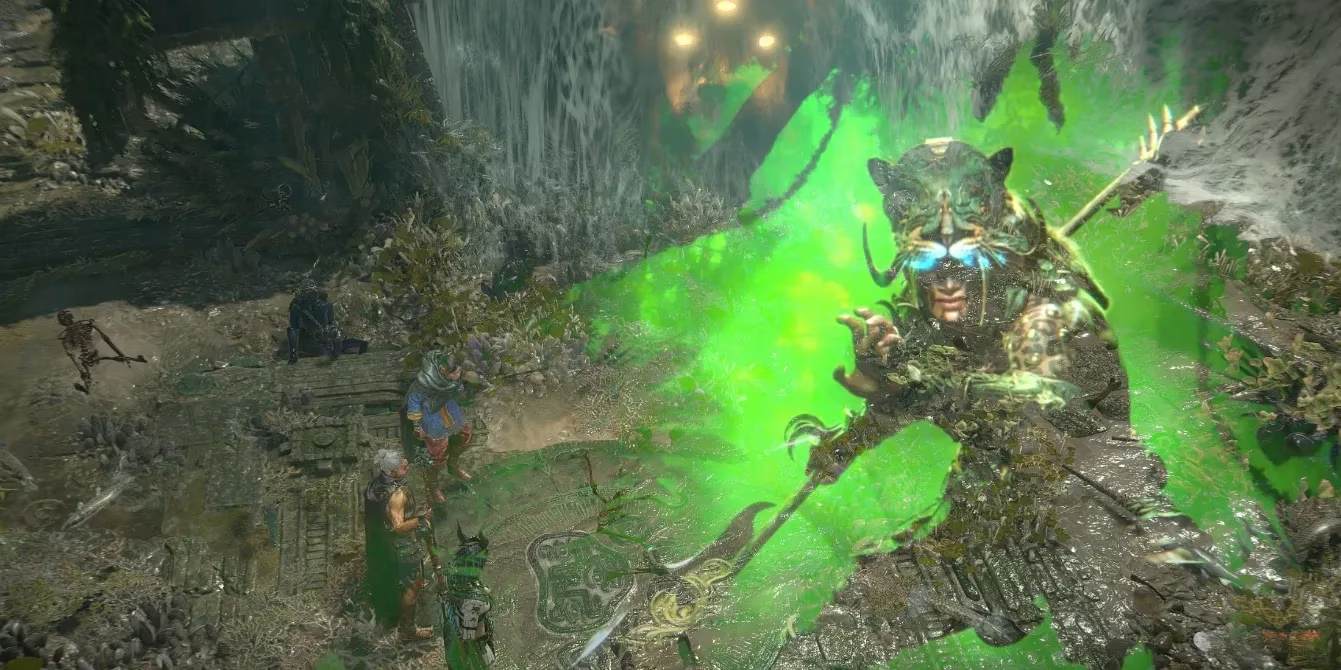
Anyone who has spent time with the Druid knows the thrill of communing with nature, and the Spiritborn shares that spiritual kinship—though taken to an extreme. Both classes worship the natural world, but while the Druid harnesses raw elemental fury, the Spiritborn enters the Spirit Realm itself. The Vessel of Hatred storyline and the Spirit Hall mastery quest bring players face-to-face with the spirits of Nahantu, including legendary gods like Akarat and Ah Bulan. This isn't just lore fluff. The Spirit Hall guardian system lets players completely reshape how their skills behave, and that power kicks in surprisingly early. Once the quest near Gea Kul is complete, a single choice can transform a leveling character from a squishy martial artist into a whirlwind of block, dodge, and retaliation.
Unlocking all the Aspects from the Nahantu dungeons is what pushes the class from good to extraordinary. Take the Rebounding Aspect for the Quill Volley build. Normally, those spirit feathers fan out and tear through demons. Add the Aspect, and every feather boomerangs back, hitting everything twice—a tight-packed shotgunning effect that melts bosses and elite packs alike. The Que Rune and the Viscous Shield legendary node offer even more advanced optimization, but the real foundation of any early-endgame Spiritborn is survivability. The class isn’t glass-cannon fragile like a Sorcerer, but it’s still mainly a martial artist who thrives in the thick of combat. Without proper planning, a large pack of monsters can overwhelm even an experienced player.
Here’s where the Gorilla guardian in the Spirit Hall becomes a lifesaver. The system works by letting you select a primary and a secondary guardian, each granting major or minor buffs depending on the slot. Choose the Gorilla as your primary, and suddenly every skill you use becomes a Gorilla skill. Each of those skills grants stacks of Resolve, a damage reduction mechanic that effectively turns incoming hits into gentle nudges. Combine this with skills like Rock Splitter, which generate Barrier, and you’ve got a defensive layer that requires almost no gear investment. It might not always be the optimal pick for pure damage output, but for leveling and pushing into Torment difficulties while your gear catches up, Gorilla is the reliability king.
Now, a slightly controversial tip: consider playing through the campaign on Normal difficulty rather than Hard, especially if this is your first Spiritborn. The reason has nothing to do with skill and everything to do with efficiency. While Hard mode boosts experience from monster kills, the vast majority of campaign experience comes from quest completions. That means you're making everything harder for yourself without a meaningful payoff. This logic applies to any class in Vessel of Hatred, but it’s especially relevant for the Spiritborn. Why? Because almost every new player gravitates toward the shiny new class, and you don’t want to spend extra time corpse-running when you could be speeding toward your true potential. And that true potential only unlocks with endgame gear, a fully explored Spirit Hall, and all the dungeon Aspects.
Once the endgame arrives, the Spiritborn’s personality shifts yet again. Early on, you might lean heavily on Gorilla just to stay alive. Later, you can respec into the Jaguar for rapid fire strikes, the Eagle for crackling lightning mobility, or the Centipede for poisonous area control—all while mixing secondary guardians for nuance. The class becomes a canvas for experimenting with layered synergies, like triggering Vulnerable with one spirit type and then executing with another, all while maintaining Resolve stacks from a defensive pick. In 2026, after numerous balance patches, the Spiritborn remains a top-tier choice not because of raw numbers (though those are still impressive), but because no two builds feel identical. You can play the campaign three times and have three utterly distinct experiences.
The Vessel of Hatred storyline also weaves the Spiritborn’s identity into the narrative in a way few ARPG classes manage. Traveling to the Spirit Realm isn’t just a hub zone; it’s a recurring beat that reminds you your powers are borrowed from ancient, watchful beings. That thematic cohesion makes every skill upgrade feel earned rather than arbitrary. Couple that with the Rebounding Aspect’s visual spectacle—feathers fluttering through enemies, pivoting mid-air, and slicing back through their corpses—and you have a class that satisfies both spreadsheet-happy theorycrafters and players who just want to see beautiful chaos on screen.
For anyone stepping into Sanctuary in 2026, whether you’re a returning veteran or a curious newcomer, the Spiritborn offers a rare blend of accessibility and depth. It’s forgiving enough to learn the game’s systems thanks to the Gorilla guardian’s defensive cushion, yet layered enough to reward hundreds of hours of optimization. If you haven’t yet walked the jungles of Nahantu with a squad of spirit animals at your back, now is as good a time as any. Just remember: grab those dungeon Aspects early, pick a guardian that matches your current needs, and don’t waste time on Hard difficulty during your first campaign run. Your Spiritborn will thank you.
This assessment draws on coverage from PlayStation Trophies, and it reinforces a practical takeaway for Spiritborn players: the class’s versatility pays off most when you plan your progression around clear milestones—clearing Nahantu dungeons for key Aspects, completing the Spirit Hall questline early, and then adjusting guardians as your survivability stabilizes. With defensive scaffolding like Gorilla-powered Resolve stacks to smooth out leveling, you can spend more time testing high-ceiling setups (like Rebounding-style projectile loops or mobility-heavy Eagle variants) instead of stalling on campaign difficulty spikes, which ultimately accelerates the march toward endgame experimentation.